
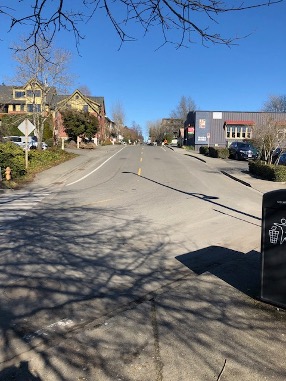
Madison Avenue now covers part of what was historically Madrone Creek, which exited to an inlet just to the east.
We aren’t April fooling- this is a stream! Or it was. Underneath Madison Avenue lies parts of Madrone Creek. Jerry Elfendahl, in Streams of Bainbridge Island, says the town’s first steamer landing was located near this creek, and that in the 1920s and 30s, a plank bridge extended across the inlet into which this stream drained, offering passage through the woods and into town. Now, this stream is nearly entirely contained in pipes and cement outfalls that enter the north side of Eagle Harbor.
By the 1970s, the City of Winslow had established a stormwater management utility, and covering the stream was likely a way to create more room for development and reduce flooding concerns. Today, you can find a few remnants of what used to be this watercourse in a few swales and ditches north of Winslow Way- but not much else. Madison is unfortunately not the only example of a stream that has been undergrounded in the name of “progress”. There are many streams in our region and across the country that have been channelized, culverted, and even fully undergrounded for stormwater and development purposes.
Fortunately, we have made progress in our treatment of streams, and fully piping and covering streams isn’t something we do in this country today. We have better regulations and protections of streams that don’t allow these types of drastic changes (though the headwaters of streams are less well protected… that’s a whole issue worth writing about at another time). In fact, there are some great examples where cities like Providence, Rhode Island, have recognized the value of their streams, uncovering and returning the function of the streams. I don’t know whether we’d ever consider such a restoration of Madrone Creek within our reach. But its important to understand the history of how we treated streams, and that we can do a lot better in protecting these critical waterways.