
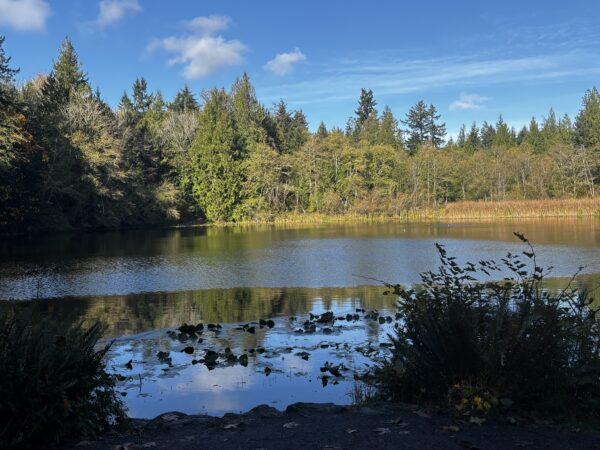
If you’ve spent any time on the IslandWood campus, this photo probably looks familiar. This is Mac’s Dam pond, in the upper reaches of the Mac’s Creek watershed. This watershed encompasses much of the IslandWood campus and drains into upper Blakely Harbor.
Friend of the Watershed Council Gerry Elfendahl tells us in his wonderful Streams of Bainbridge Island that Mac’s Creek and the Dam were named for Malcolm McDonald. McDonald was a hotel manager and later, owner of the Pleasant Beach hotel, whose Eagledale farm was on McDonald Road. The pond was used for mill water, fire control, and a source of drinking water for Port Blakely’s residents. Today, Mac’s pond features a floating classroom where IslandWood students come to learn about the pond and its surrounding ecology. The pond is home to aquatic invertebrates, visiting ducks, herons, and raptors, and even beaver, who have established a lodge at the far side of the pond (hidden behind the reeds at the back of this picture). And… fish? Read on about how we are trying to figure out if there are fish in the stream and pond…
The Watershed Council received a small grant this year from the Bainbridge Community Foundation to team up with Wild Fish Conservancy to look at fish presence and diversity in Mac’s Dam and Creek. We are interested in studying this stream because the City and IslandWood are pursuing the removal of an old check dam downstream of the pond that currently forms a complete barrier to fish passage. Knowing that this structure is slated for removal, we thought it would be interesting and informative to get some baseline data about whether fish are in this system, how far up they are, and what kinds of fish they might be. From historic information and observations, we might expect both cutthroat trout and coho salmon to be using accessible parts of this stream system, and possibly other fish species as well. We are using an environmental DNA sampling approach to collect samples from the stream and test them for a wide variety of fish species, as well as other kinds of wildlife. Stay tuned for those findings!