
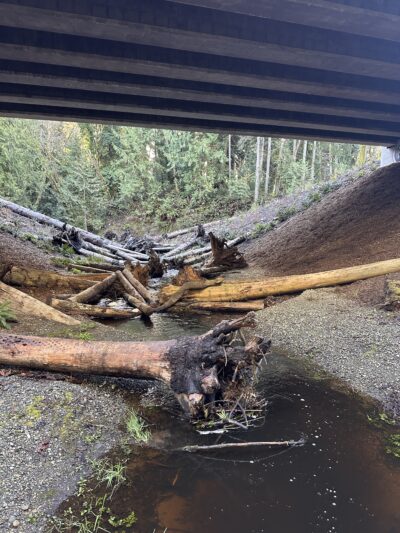
Underneath 305, WADOT has replaced what was an undersized culvert with an open bridge and added large wood to restore stream function and habitat on Daxwkw’d sáxwb Creek
Here’s a crossing that is a bit hard for most folks to see, but my friend at COBI, Christian Berg, was kind enough to share a couple of recent pics. This is the new bridge on Highway 305 on Daxwkw’d sáxwb Creek, also known locally as Murden Creek. This open channel that now has room for the stream to move and better habitat replaced what was for decades an undersized culvert that created a partial fish passage barrier on the stream.
Daxwkw’d sáxwb Creek (a Western phonetic pronunciation is “DOE-Qwap-Sah-Qwap”) means “the place which gets jumping”. The Suquamish Tribe passed a resolution in 1997 asking for this name to be retained as the official stream name by local, state and federal jurisdictions, and hopefully we can get it into more common parlance, to recognize that this is one of many places that had names long before European settlers renamed them.
Daxwkw’d sáxwb’s watershed is one of the larger watersheds on the Island. This stream’s south fork originates in springs on the eastern edge of the grand forest and its north fork originates north of Koura Road. The forks join as they pass through Meig’s Park, the largest wetland system on our Island, and eventually head underneath 305, then Madison Avenue, and into the tidal embayment of Murden Cove on the east side of the Island. If you want to dive in deeper to this watershed, head on over to the many pictures that are available from the Wild Fish Conservancy’s water typing program.
This watershed is active with beaver activity (here’s an article I wrote a few years ago on beaver activity in the upper watershed), coho salmon and cutthroat trout, waterfowl using its stream and wetlands, raptors, otters, what is believed to be the county’s largest spruce, a remnant peat bog (likely far more extensive prior to peat mining and gravel extraction around Meigs) and so much more. And as you know if you’ve visited Meigs Park, lots and lots and lots of invasive plants, including acres of reed canary grass and what I’d consider old growth scotch broom. It is a watershed of amazing vitality, diversity, and potential; removing fish barriers and regaining natural stream channel is an important step in restoring this watershed’s health.