
The 2026 Bainbridge Island Environmental Conference took place March 29, 2026 at IslandWood on Bainbridge Island.
The 2026 Bainbridge Island Environmental Conference: Rising Seas, saw more than 100 community members, local and regional organizations, jurisdictions and agencies gather together to discuss the science and impacts of sea level rise and what it means for us as an Island community and region. Below you will find a summary and highlights of the conference, with links to slides from many of our presenters. We are incredibly grateful to all our speakers, tablers, and of course our community, who showed up in force to learn and discuss this important issue, and hopefully left with many ideas for both personal and collective action to better prepare and respond to rising sea levels.
The conference was preceded by two field trips on Saturday March 28, lead by Shore Friendly Kitsap and Bainbridge Island Parks & Recreation District to visit local shorelines where these groups are working on solutions to impacts of sea level rise on private and public properties.
And available any time: the DIY Sea Level Rise Field Trip! Print and take this map with you to take a self-guided tour of the Island to areas vulnerable to sea level rise, to get first-hand experience of the types of infrastructure and habitats that are at risk from rising seas. We highly recommend doing this field trip at or near a King Tide, as these higher tides are harbingers of the tidal elevations sea level rise will make increasingly common in the coming decades.
Opening Session
Opening remarks: Azure Bouré, Suquamish Tribal Councilwoman
Azure is a member of the Suquamish Tribal Council and the Tribe’s Traditional Food & Medicine Program Coordinator. Azure welcomed us to the conference and spoke of the importance of tribal food sovereignty to her work and the ways in which climate change threatens tribal wellbeing, and expressed gratitude in learning alongside all of us on this issue.

Mike Cox expresses thanks for this award and tells us he does this work every day for his granddaughter
Environmentalist of the Year
Michael Cox received the Jerry and Elaine Helmuth Environmentalist of the Year Award. This award has been a part of the Environmental Conference since its inception, and honors a Bainbridge resident who has shown leadership in one or more areas of environmental sustainability or advocacy. Mike is a worthy recipient of this award for his substantial contributions to the environmental field, both as a career EPA professional and subsequently in his retirement on Bainbridge for the many groups and issues he has been involved with and led on climate and energy issues. Mike left us with not a dry eye as he talked about his granddaughter as his daily inspiration for doing this work.
Plenary Speaker: Sydney Fishman, Washington Sea Grant
Sydney Fishman is the Coastal Management Specialist at Washington Sea Grant, where she helps shoreline and coastal decision-makers find solutions to their complex management issues. Sydney’s talk delved into the science that helps us understand how and how quickly sea levels are rising in Puget Sound and beyond, and talked about ways in which we can communicate, share knowledge, and grow awareness of this issue throughout the region. Sydney’s slides are available here.
Breakout Sessions
Five concurrent breakout sessions were available to participants, and a brief summary and resources when available are provided for each of these below.
Art as the Water Rises
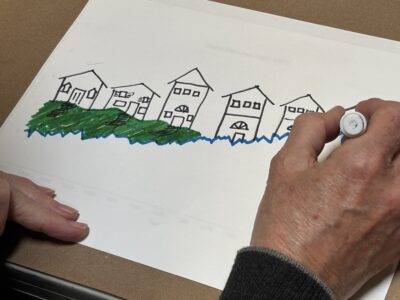
A participant in the Jill Pelto’s breakout session uses global sea level rise data to create art
Artist Jill Pelto lead a hands-on activity to explore how art can communicate the science, emotion, and urgency of sea level rise, and how creative expression can inspire awareness and action. Jill is a Bellingham-based environmental artist who mixes scientific data with artistic expression to communicate the urgency of conservation and climate issues in a unique and beautiful way; we were so grateful to have her join us to lead this session.
Check out more of Jill’s wonderful climate art here.
Local Government Planning and Action Facilitators: Laura Rÿser, City of Bainbridge Island; Jim Roger, Kitsap County
City and County staff explored how local governments are planning for sea level rise, including infrastructure, land use, and policy responses at multiple scales. Facilitators asked the audience their reasons for attending, and responses included:
- many attendees were broadly interested in what the City and County are doing on the issue of sea level rise;
- some came specifically to listen for solutions including managed retreat, managing for saltwater intrusion, and community planning to prepare, including how these plans fit into comprehensive planning;
- several attendees worked with local government and wanted to hear more about community perspectives; and
- some expressed a specific shared commitment to change starting at the local level, and wanting local government staff and council to commit to adaptation planning and implementation.
Laura and Jim’s slides are available here.
Shared Ground: Habitat, People & Parks Facilitators: Matt Lurie, WA Department of Fish and Wildlife (WDFW); Morgan Houk, Bainbridge Metro Parks; Heidi Urish, Bainbridge Island Parks & Trails Foundation
Morgan used Fay Bainbridge Park as a case study for exploring sea level rise impacts, including both recreational and ecosystem services currently provided at the park. The Reverse Time Capsule: an interactive sea level rise sculpture, has also recently been installed here through a partnership with Bainbridge Parks & Recreation District, Bainbridge Parks & Trails Foundation, EcoAdapt, and the Rotary Club of Bainbridge Island. Heidi talked about conservation and access at Fay Bainbridge and the importance of connecting awarenesss and stewardship, and the role of the Foundation in supporting conservation and recreational goals including trails and infrastructure. Matt talked about WDFW’s Habitat Strategic Initiative to protect habitat and the biodiversity it supports. He discussed the importance of sea level rise impacts on habitat loss, water quality changes, erosion and more, and how shoreline practices can exacerbate, or mitigate, impacts depending on actions like shoreline armoring vs. protection and restoration.
Slides for the Shared Ground breakout session are available here.
Natural Resource Management in a Changing Coastal Landscape Facilitators: Ben Harrison, Port Gamble S’Klallam Tribe; Megan Rohrrsen, Bainbridge Island Land Trust, Theo Suver, Suquamish Tribe
This group explore how sea level rise is affecting wildlife and ecosystems, highlighting responses from parks, land trusts, Tribes, and state agencies addressing coastal squeeze, habitat protection, and stewardship of natural areas. Participants had a robust discussion around the importance of both management and monitoring to address coastal processes like surface runoff, erosion, and sediment transport to understand how sea level rise will affect these processes. Conversations around shoreline armoring were also a focus, with acknowledgement that while the growth curve of installations has flattened, financial incentives are limited and there is more to do in streamlining permitting and supporting soft-shore alternatives that are better at supporting nearshore habitat.
Theo Suver, Suquamish Tribal Biologist’s slides here on Forage Fish Spawning in a Rising Sea.
Ben Harrison, Port Gamble S’Klallam Tribe Environmental Scientist’s slides here on Sea Level Rise and Coastal Habitat.
Beyond Our Shores: Large-scale Adaptation Approaches Facilitator: Lara Hansen, EcoAdapt
Lara put our community responses to sea level rise in larger scale contexts, positing that we can’t do everything we need to about sea level rise on Bainbridge Island, so what can we influence beyond our shores at the regional, state, national and international scales – for people and nature? Lots of questions and brainstorming in this group lead to some important takeaways and ideas to pursue in this larger context, including:
- Central question of how we move City, regional and state entities to address sea level rise
- At the local level, zoning, insurance and finance are the entities that could limit homes being built in high-risk locations
- But local jurisdictions also don’t want to be sued for not allowing building, and point to the importance ofg insurance companies refusing to insure high-risk properties; while insurance companies point to mortgage and finance that could refuse to lend… turning into a stalemate. How do we escape that circle? Can the insurance commissioner provide oversight, and require longer-term insurance?
- State could create model legislation that regional entites could adopt.
- Implications of sea level rise for wastewater infrastructure and septic: the importance of the role of both County (Kitsap Public Health) and state as well as federal (US EPA) engagement on this issue
- FEMA’s important role in hazard mitigation, and its increasing importance in the context of sea level rise increasing vulnerability. Currently, FEMA maps often do not include financial and insurance risks, which does not support good decision-making.
- The importance of restoration and actions that support habitat migration:
- shoreline de-hardening at scale- Puget Sound or Salish Sea scales: do we need a climate-ready workforce including more capability for bulkhead removal and alternatives?
- Floodplain reconnectivity to allow for increased water dispersal
- Dam removal and increasing hydrologic health and connectivity
- Could coastal communities come together to work more regionally on these issues? Can neighborhoods come together to address risks and increased costs that could arise if homes are abandoned or infrastructure is not maintained?
The Environmental Conference wrapped up with an activity where participants were asked to leave sticky notes or a self-addressed envelope that stated a personal or collective action they were planning to take as a result of what they learned over the day. These postcard will be mailed to participants in the fall, to remind them of their pledge and of next year’s conference (topic TBD!).
2026 Bainbridge Island Environmental Conference Planning Partners
